Japanese name generator
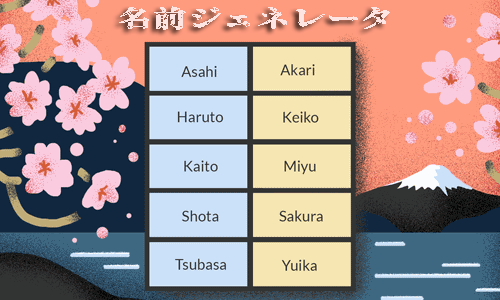
Get unlimited common and popular Japanese names with this Japanese name generator tool. Simply refresh the page to get more. Every name shows with Kanji, Hiragana and Katakana.
Male Name[1]
Kanji:金田吉洋
Hiragana:かねだよしひろ
Katakana:カネダヨシヒロ
Female Name[1]
Kanji:金田心音
Hiragana:かねだみおん
Katakana:カネダミオン
Male Name[2]
Kanji:黒木良弘
Hiragana:くろきよしひろ
Katakana:クロキヨシヒロ
Female Name[2]
Kanji:黒木心穏
Hiragana:くろきみおん
Katakana:クロキミオン
Male Name[3]
Kanji:野崎佳博
Hiragana:のざきよしひろ
Katakana:ノザキヨシヒロ
Female Name[3]
Kanji:野崎未穏
Hiragana:のざきみおん
Katakana:ノザキミオン
Male Name[4]
Kanji:藤沢善大
Hiragana:ふじさわよしひろ
Katakana:フジサワヨシヒロ
Female Name[4]
Kanji:藤沢光音
Hiragana:ふじさわみおん
Katakana:フジサワミオン
Male Name[5]
Kanji:堤善弘
Hiragana:つつみよしひろ
Katakana:ツツミヨシヒロ
Female Name[5]
Kanji:堤弥恩
Hiragana:つつみみおん
Katakana:ツツミミオン
Japanese surnames generally consist of one to three kanji, and a few also have more than four kanji. The first name is usually composed of two words.
Ancient Japanese had no surnames, only first names. In 1870, in order to meet the needs of conscription, taxation, and the creation of family registers, Emperor Meiji issued the "Civilian Miao Character Permitting Order", which allowed all Japanese, including commoners who did not previously have a surname, to have a surname. However, Japanese civilians, who had become accustomed to having names and no surnames, were not enthusiastic about this, so the work of creating surnames was slow. Therefore, in 1875, Emperor Meiji issued the "Commoner Seedling Character Decree", which stipulated that all Japanese must use surnames. Since then, every household in Japan has had a surname.
After the Japanese get married, because the law prohibits the husband and wife from having different surnames, the wife usually changes to the husband's surname, and if it is a son-in-law, it is changed to the woman's surname.
The Japanese are the most surnamed ethnic group in the world. According to statistics, there are about 110,000 surnames in Japan, of which there are more than 400 of the most common.
The pronunciation of Japanese surnames is so complex that even Japanese people themselves cannot figure it out very thoroughly. The same pronunciation may correspond to dozens of Chinese characters, and the same set of Chinese characters may have several readings, or even no regularity at all. This may indirectly contribute to the Japanese society's heavy reliance on business cards: the public needs romanization or kana on business cards to accurately pronounce each other's names.
The order of Japanese surnames and given names is that the last name comes first and the first name comes last.